
Income tax compliance is an essential part of financial management for businesses, professionals, and organisations. As businesses increasingly use digital accounting solutions, professionals need more than theoretical tax knowledge; they also need practical skills to manage accounting data, calculate taxes, prepare reports, and support compliance processes efficiently.
An Income Tax Course using TallyPrime can help learners develop practical accounting and taxation skills while becoming familiar with a widely used business accounting environment. In 2026, combining taxation knowledge with accounting software skills can be useful for students, accounting professionals, business owners, and individuals looking to build a career in finance and taxation.
A practical course can help learners understand how accounting transactions connect with taxation requirements and how financial information can be organised for reporting and compliance.
What Topics Are Covered in an Income Tax Course Using TallyPrime?
The exact syllabus can vary between courses, but a comprehensive Income Tax Course generally covers several important areas.
1. Fundamentals of Income Tax
Beginners can learn the basic concepts of income tax, including taxable income, financial years, assessment years, different sources of income, and fundamental taxation terminology.
Understanding these concepts provides a foundation for working with tax-related accounting information.
2. Accounting and Taxation Concepts
Income tax calculations depend heavily on accurate financial records. Learners can understand how accounting transactions influence taxable income and why maintaining organised books of accounts is important.
Using TallyPrime during practical training can help students connect accounting concepts with day-to-day business transactions.
3. Recording Business Transactions
Practical training may include recording sales, purchases, expenses, receipts, payments, and other transactions. Learners can understand how properly recording transactions helps businesses maintain accurate financial information.
This skill can be particularly valuable for accounting assistants and junior finance professionals.
4. Tax-Related Reports and Financial Data
An important part of taxation work is extracting and reviewing relevant financial information. Learners can develop skills in generating reports, checking transaction records, and analysing accounting data.
These capabilities can make it easier to identify discrepancies and prepare information required for further tax-related processes.
5. Payroll and Income Tax
Some comprehensive taxation courses also introduce learners to payroll-related taxation concepts. This can help professionals understand how employee salary information, deductions, and statutory requirements relate to payroll management.
For learners interested in both taxation and payroll, combining these skills can broaden their career opportunities.
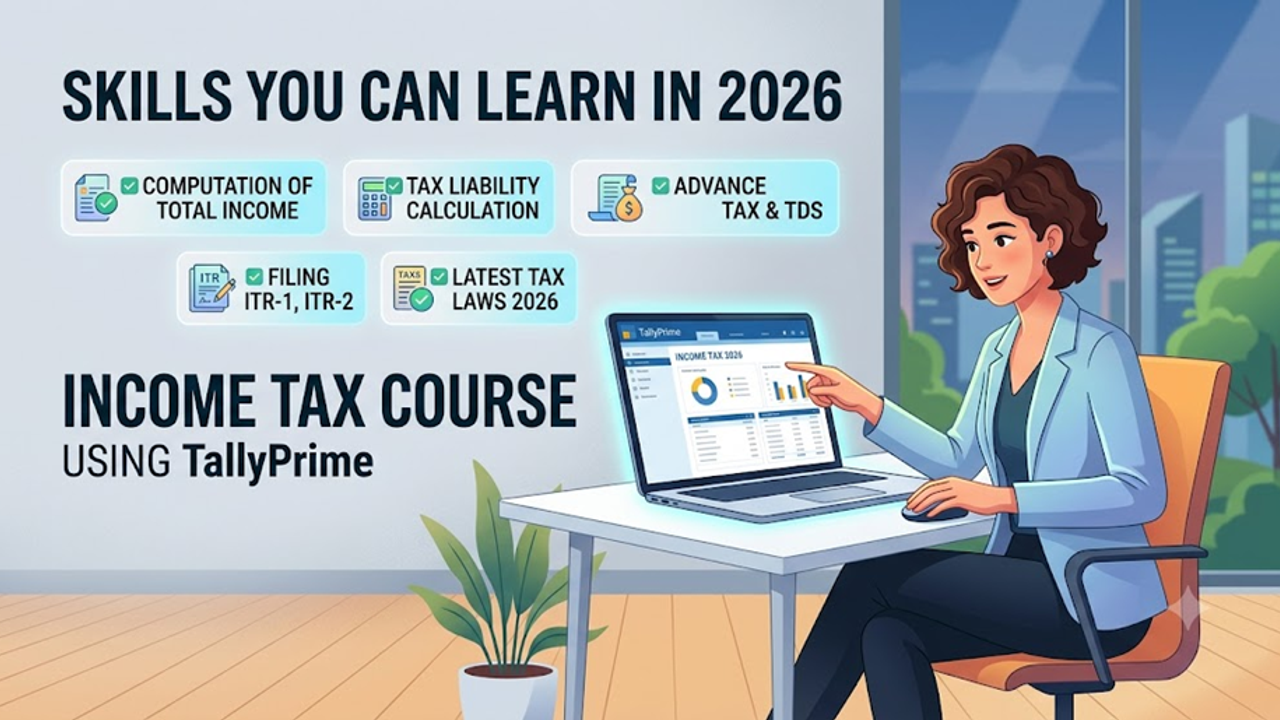
Skills You Can Learn in 2026

A modern Payroll and Income Tax Course can help learners develop a combination of technical and practical skills.
Some key skills include:
- Understanding basic income tax concepts
- Maintaining accounting records
- Recording business transactions
- Generating financial reports
- Working with TallyPrime
- Understanding taxation-related accounting processes
- Reviewing financial information
- Supporting tax and compliance activities
- Managing payroll-related information
- Improving accounting accuracy
The biggest advantage of practical learning is that students can understand how accounting and taxation concepts are applied in real business situations rather than relying only on theoretical knowledge.
How to Choose the Right Income Tax Course Using TallyPrime in 2026
With many accounting and taxation courses available, choosing the right programme requires careful evaluation.
Check the syllabus: Make sure the course covers the taxation and accounting concepts you want to learn.
Look for practical training: Software-based practice can help you understand how accounting processes work in real-world situations.
Consider certification: A recognised course certificate can help demonstrate your training when applying for accounting or finance-related positions.
Evaluate the software training: If you want to work in accounting, choose a course that provides practical exposure to TallyPrime and relevant accounting processes.
Consider your career goal: Students, business owners, accounting assistants, payroll professionals, and finance executives may have different learning requirements.
For learners looking for structured training, Tally Education offers a Complete Guide to Payroll & Income Tax course that combines relevant accounting, payroll, and income tax concepts.
Career Opportunities After an Income Tax Course
Practical knowledge of accounting and taxation can support career paths such as accounting executive, junior accountant, tax assistant, payroll executive, finance assistant, and accounts administrator.
While completing a course does not guarantee employment, combining certification with practical software skills can strengthen a candidate's profile and help them demonstrate job-relevant capabilities.
Conclusion
An Income Tax Course using TallyPrime can be a useful learning option in 2026 for anyone interested in accounting, taxation, payroll, or finance. By combining tax fundamentals with practical accounting and software skills, learners can develop capabilities that are relevant to everyday business operations.
For the best results, choose a course that offers a structured syllabus, practical training, software exposure, and certification. Building these skills can provide a stronger foundation for pursuing opportunities in accounting and taxation.